
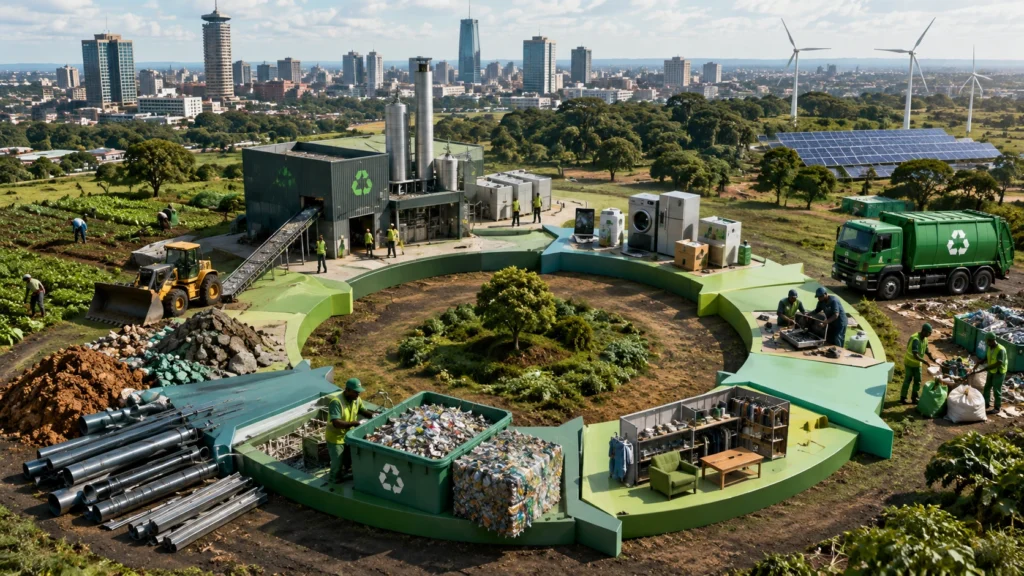

Africa’s economies are facing a combination of rapid population growth, urbanisation, rising consumption, resource pressures and growing waste volumes. These trends create significant challenges, but they also create an opportunity to rethink how products, materials and resources move through the economy.
The circular economy in Africa is about more than recycling.
It is about changing how products and services are designed, how resources are used, how businesses create value and what happens to products and materials after use.
The approach is increasingly relevant to African businesses, governments, cities and communities because it can connect resource efficiency with economic development, innovation and environmental goals.
This guide explains what the circular economy is, its core principles, circular business models, the opportunities and challenges in Africa, and practical steps organisations can take to begin moving from a linear to a more circular approach.
What is a circular economy?
A circular economy is an economic system designed to eliminate waste and pollution, keep products and materials circulating at their highest possible value and regenerate nature.
The Ellen MacArthur Foundation defines the circular economy around three principles:
- Eliminate waste and pollution
- Circulate products and materials
- Regenerate nature
These principles are driven by design. The objective is not simply to manage waste after it has been created, but to rethink systems so that waste and pollution are designed out wherever possible.
This differs from the traditional linear model.
The linear economy
A simplified linear model follows:
Take → Make → Use → Dispose
Raw materials are extracted, converted into products, consumed and eventually discarded.
The circular economy
A circular approach seeks to:
Design → Use → Maintain → Reuse → Repair → Refurbish → Remanufacture → Recycle
The exact pathway depends on the product, material and system involved.
The important idea is that products and materials should remain useful for as long as possible rather than becoming waste after a single use.
Why does the circular economy matter?
The case for circularity starts with the way humanity uses natural resources.
According to the UN Environment Programme’s International Resource Panel, global resource use increased from 30 billion tonnes in 1970 to 106 billion tonnes in 2019. The same assessment found that extraction and processing of resources account for more than 60% of planet-warming emissions and about 40% of health-related impacts from air pollution.
The Global Resources Outlook 2024 also found that material use has increased more than threefold over the past 50 years and continues to grow by more than 2.3% per year. Without major changes, resource extraction could increase by almost 60% from 2020 levels by 2060.
This matters because economic activity depends on material flows.
Businesses need:
- energy
- metals
- minerals
- agricultural products
- water
- timber
- plastics
- construction materials
- manufactured components
A circular economy asks a different question:
How can we create more value while using resources more effectively and keeping products and materials in productive use for longer?
That question is particularly important for economies seeking to expand production and improve living standards while managing environmental pressures.
The three principles of the circular economy
1. Eliminate waste and pollution
The first principle is to design waste and pollution out of economic systems.
This starts before a product becomes waste.
Product design influences:
- durability
- repairability
- material selection
- recyclability
- resource use
- packaging
- product lifespan
If a product is designed to be discarded after a short period, recycling alone cannot solve the underlying problem.
Circular design instead asks whether waste can be prevented in the first place.
The Ellen MacArthur Foundation describes this as moving away from a system where waste is an unavoidable outcome of production and consumption.
2. Circulate products and materials
The second principle is to keep products and materials in use.
This can involve:
- maintenance
- repair
- reuse
- sharing
- refurbishment
- remanufacturing
- recycling
The order matters.
In many situations, retaining a product’s function through maintenance, reuse or repair preserves more value than breaking it down into materials.
For example, extending the useful life of a piece of equipment can retain the value embodied in its materials, manufacturing, labour and energy.
Where a product can no longer be used, components may still have value. Where components cannot be recovered, materials may potentially be recycled.
The objective is to retain value for as long as technically and economically practical.
3. Regenerate nature
The third principle extends circular thinking beyond manufactured products.
Biological resources can, where appropriate and safely managed, return to natural systems.
Examples can include:
- composting organic materials
- returning nutrients to soils
- regenerative agricultural practices
- restoring ecosystems
- protecting biodiversity
The goal is not simply to reduce environmental damage.
It is also to support the regeneration of natural systems on which economies depend.
Circular economy vs recycling: what is the difference?
Recycling is an important part of circularity, but a circular economy is much broader than recycling.
Recycling generally involves processing used materials so that they can become inputs for new products.
Circular economy thinking starts earlier.
It asks:
Can we avoid creating the waste?
If not:
Can the product be reused?
If not:
Can it be repaired or refurbished?
If not:
Can components be recovered or remanufactured?
And finally:
Can the materials be recycled safely and economically?
This distinction matters because a system that produces large quantities of waste and relies heavily on recycling may still be relatively inefficient compared with one designed to prevent waste and extend product lifetimes.
What are circular economy business models?
A circular economy also changes how businesses can create and capture value.
Traditional businesses often generate revenue by selling products.
Circular business models can create value by extending product life, increasing utilisation, recovering materials or providing access instead of ownership.
Examples include the following.
Product-as-a-service
Customers pay for access to a product or service rather than necessarily purchasing and owning the physical product.
This can create an incentive for providers to design products that last longer and are easier to maintain.
Reuse and resale
Products are sold or transferred to additional users instead of being discarded after their first owner no longer needs them.
Digital platforms can make these models easier to organise at scale.
Repair and maintenance
Businesses can generate revenue by keeping products operational for longer.
This can include:
- maintenance contracts
- repair services
- spare parts
- refurbishment
- predictive maintenance
Refurbishment
Used products can be restored to a functional condition and returned to the market.
This can preserve some of the value embedded in the original product.
Remanufacturing
Components can be recovered and re-engineered to meet defined performance requirements.
Remanufacturing is more extensive than simple repair and can be an important circular strategy for suitable products.
Resource recovery
Businesses can recover valuable materials or other resources from waste streams.
This can be particularly relevant where materials have sufficient economic value to justify collection, sorting and processing.
Why the circular economy is important for Africa
The circular economy in Africa needs to be considered within the continent’s own economic and infrastructure context.
Africa is not a single market, and conditions vary substantially between countries and regions.
However, several broad trends make resource efficiency and circularity increasingly relevant.
The World Bank’s latest What a Waste 3.0 dataset, based on data from 217 countries and economies and 262 cities, estimates that the world generated 2.56 billion tonnes of municipal solid waste in 2022. Under a business-as-usual scenario, this could rise to 3.86 billion tonnes by 2050.
The same World Bank analysis identifies Sub-Saharan Africa as one of the fastest-growing waste-generating regions, with waste generation projected to increase by 124% by 2050 under the business-as-usual scenario.
Waste collection is another major issue.
The World Bank reports that waste collection rates in Sub-Saharan Africa can be as low as 31%, leaving significant quantities of waste outside formal collection systems.
These figures should not be interpreted as meaning that waste is Africa’s only circular economy opportunity.
They demonstrate something broader:
Rapidly growing material flows require systems capable of keeping resources in productive use while reducing waste and environmental impacts.
That creates opportunities across production, agriculture, manufacturing, construction, services, logistics and urban development.
Circular economy opportunities in Africa
The Ellen MacArthur Foundation’s work on the circular economy in Africa identifies opportunities across sectors including automotive, the built environment, electronics and e-waste, fashion and textiles, finance, food and agriculture, plastics and policy.
These sectors illustrate why circularity should not be treated simply as a waste-management issue.
Agriculture and food systems
Agriculture creates opportunities to improve resource use through:
- nutrient recovery
- organic waste management
- composting
- efficient use of agricultural by-products
- regenerative approaches
- improved food supply chains
The objective should be to identify where biological resources can safely remain productive rather than becoming avoidable waste.
Plastics
Plastic products can provide useful functions, but poorly designed or managed plastics can create significant environmental impacts.
UNEP reports that global plastic waste could nearly triple by 2060 under a business-as-usual scenario.
Circular strategies can include:
- eliminating unnecessary plastic
- redesigning products
- reducing problematic materials
- reuse systems
- improved collection
- recycling
- better product and packaging design
UNEP’s Turning off the Tap report specifically examines the economic and business-model changes needed to move toward a circular plastics economy.
Electronics and e-waste
Electronic products contain valuable materials but can also contain hazardous substances.
Circular strategies include:
- longer product lifetimes
- repair
- refurbishment
- component recovery
- responsible recycling
- improved collection systems
E-waste therefore sits at the intersection of circular economy, resource recovery, product design and environmental management.
Construction and the built environment
Construction requires substantial quantities of materials.
Circular approaches can include:
- designing buildings for adaptability
- extending building lifetimes
- renovation instead of unnecessary demolition
- reuse of building components
- material recovery
- design for disassembly
UNEP has highlighted the scale of the opportunity in the built environment, noting that half of the buildings expected to exist by 2050 have not yet been built, with much of this growth occurring in the Global South.
This makes design decisions today particularly important.
Manufacturing
Manufacturers can explore circularity through:
- longer-lasting products
- modular design
- repairability
- remanufacturing
- industrial symbiosis
- material efficiency
- recovery of production waste
The strongest opportunities will differ by sector.
A circular strategy for an electronics manufacturer will not necessarily be the same as one for a food processor or construction company.
The role of informal workers in Africa’s circular economy
Any serious discussion of the circular economy in Africa must consider informal workers.
Collection, sorting, repair, reuse and recycling activities can involve large numbers of workers outside formal employment systems.
The World Bank estimates that the global urban waste sector already employs around 18 million people, with employment concentrated in collection, sorting and recycling. It also highlights the important role of informal workers, particularly in lower-income countries.
This means circular economy policies should not focus only on technology and infrastructure.
They also need to consider:
- livelihoods
- worker safety
- skills
- access to finance
- formalisation where appropriate
- fair participation
- market access
A circular transition that creates environmental improvements while excluding people who already participate in resource recovery would be incomplete.
Circular economy and climate change
Circular economy strategies can contribute to climate action, but they should not be treated as a substitute for decarbonising energy systems.
The International Resource Panel reports that extraction and processing of materials account for more than 55% of global greenhouse gas emissions, rising to more than 60% when land-use change is included in the assessment.
The Ellen MacArthur Foundation estimates that 45% of global greenhouse gas emissions are associated with the way products, food and land are produced and used.
This is why circular economy thinking can complement renewable energy and energy efficiency.
Circular strategies can address emissions associated with:
- material production
- product manufacturing
- food systems
- land use
- waste
- product replacement
However, the climate impact of any specific circular strategy should be assessed rather than assumed.
For example, transporting used materials over long distances, processing them inefficiently or replacing a durable product with a less durable alternative may produce outcomes different from those expected.
This is where life cycle assessment and GHG accounting become important.
Circular economy and life cycle assessment
Circularity and environmental impact are related, but they are not identical.
A circular strategy can change material flows without automatically guaranteeing the lowest environmental impact.
Life cycle assessment (LCA) can help organisations evaluate environmental impacts across the life cycle of products, services or systems.
For example, a company considering whether to:
- reuse a component
- refurbish it
- recycle it
- replace it
may need to evaluate the energy, materials, transport and other impacts associated with each option.
This is one reason Planet Kazai treats circular economy, GHG accounting and life cycle assessment as interconnected areas of sustainability knowledge rather than isolated topics.
Circular economy in Kenya
Kenya provides an important example of how circularity is becoming part of national sustainability and waste-management discussions.
Kenya’s National Sustainable Waste Management Policy includes the objective of contributing to a circular economy through improved waste management.
UNEP has also specifically highlighted Kenya’s transition from linear to circular approaches and its sustainable waste-management policy agenda.
For Kenyan businesses, circular economy opportunities can span:
- waste prevention
- reuse
- repair
- recycling
- organic resource recovery
- sustainable packaging
- product life extension
- resource-efficient manufacturing
- circular business models
The most appropriate opportunity will depend on the industry, value chain, infrastructure and economics involved.
For this reason, a circular economy strategy should begin with understanding the organisation’s actual material flows rather than adopting a generic list of “green” activities.
Circular economy policy in Africa
Government policy can influence whether circular business models are viable.
Relevant policy areas include:
- waste management
- product standards
- extended producer responsibility
- public procurement
- taxation
- trade
- infrastructure
- resource efficiency
- environmental regulation
- industrial policy
The Ellen MacArthur Foundation notes that governments and cities can use multiple policy levers to support circularity, including product policies and measures that create conditions for innovation and investment.
The African Circular Economy Alliance is one example of regional cooperation. UNEP describes ACEA as a government-led coalition supporting Africa’s transformation toward a circular economy through policy development, business scaling, leadership and advocacy. The alliance currently includes 13 African countries.
This demonstrates that circular economy policy is increasingly being considered at national and regional levels.
The economic opportunity
Circularity is not only an environmental concept.
It can also create opportunities for new businesses, products, services and employment.
UNEP has cited estimates that a circular economy could unlock US$4.5 trillion in economic growth and create six million new jobs globally, with many opportunities expected in developing countries across activities such as recycling, repair, rental and remanufacturing.
The African Development Bank has also identified circular economy opportunities in areas such as waste management, resource recovery and circular businesses. In 2024, its AfriCircular Innovators programme highlighted the potential of circular economy approaches to support employment and business development in Africa.
These figures should be treated as global opportunity estimates, not forecasts of jobs or economic growth that Africa will automatically receive.
The actual outcome depends on investment, policy, infrastructure, skills, markets and business execution.
What are the barriers to a circular economy in Africa?
The opportunity is significant, but implementation is not straightforward.
1. Infrastructure gaps
Circular systems depend on infrastructure for:
- collection
- sorting
- storage
- transport
- repair
- processing
- recycling
Where these systems are weak, potentially valuable materials can be lost.
2. Access to finance
Circular businesses can require investment in equipment, collection systems, technology and new business models.
Smaller enterprises may face particular difficulties accessing appropriate finance.
3. Data gaps
Organisations need reliable information about:
- material inputs
- waste
- product lifetimes
- recovery rates
- emissions
- environmental impacts
Without data, it becomes difficult to identify priorities or measure progress.
4. Markets for recovered materials
Circular systems require buyers.
Recovered materials must compete with virgin materials on factors such as:
- price
- quality
- reliability
- availability
Where markets for recovered materials are weak, recycling and recovery businesses can struggle.
5. Policy and enforcement
Good policy can create enabling conditions, but inconsistent implementation can reduce confidence for businesses and investors.
6. Skills and technical capacity
Circularity can require skills in:
- product design
- repair
- engineering
- materials management
- data analysis
- environmental assessment
- business model innovation
Skills development is therefore an important part of the transition.
How can a business start a circular economy strategy?
A company does not need to redesign its entire business overnight.
A practical starting point is to understand where resources enter the organisation and where value is lost.
Step 1: Map material and product flows
Identify:
- major material inputs
- energy use
- packaging
- products
- waste streams
- by-products
Step 2: Identify where value is lost
Look for:
- unused materials
- damaged products
- short product lifetimes
- unnecessary packaging
- inefficient processes
- recoverable by-products
Step 3: Examine product lifecycles
Ask:
- Can the product last longer?
- Can it be repaired?
- Can components be replaced?
- Can it be refurbished?
- Can materials be recovered?
Step 4: Identify circular business opportunities
Consider whether the organisation could introduce:
- repair services
- refurbishment
- resale
- take-back systems
- product-as-a-service
- reuse
- remanufacturing
- resource recovery
Step 5: Evaluate environmental impacts
Use appropriate data and assessment methods.
Where relevant, this can include:
- GHG accounting
- life cycle assessment
- material-flow analysis
- waste audits
- resource-efficiency indicators
Step 6: Test before scaling
Start with a defined product, process, facility or material stream.
Measure the results.
Then decide whether the approach should be expanded.
This reduces the risk of investing heavily in a circular model before its technical and economic feasibility has been demonstrated.
How should circularity be measured?
There is no single metric that can describe every circular economy system.
Useful indicators can include:
- percentage of recycled or reused inputs
- product lifetime
- repair rate
- reuse rate
- refurbishment rate
- remanufacturing rate
- material recovery rate
- waste generation
- waste diversion
- recycled content
- resource productivity
The right indicators depend on the objective.
For example, a company seeking to extend product life might prioritise average product lifetime and repair rates, while a manufacturer focused on material recovery may need different indicators.
Measurement should therefore begin with a clearly defined circularity objective.
Circular economy is not a single solution
One of the most important points to understand is that there is no universal circular economy model.
A strategy that works for food waste may not work for electronics.
A model suitable for a large manufacturer may not be appropriate for a small business.
A circular solution that works in Europe may require significant adaptation before it can work effectively in Kenya, Nigeria, Rwanda or another African market.
The principles are broadly applicable.
The implementation is contextual.
This distinction is particularly important for the circular economy in Africa, where infrastructure, markets, regulations, informal economies and business conditions vary significantly between countries.
What does a circular economy mean for African businesses?
For businesses, circularity should ultimately be connected to a business question.
That question might be:
How can we reduce material costs?
Or:
How can we extend the life of our products?
Or:
How can we create a new revenue stream from products after their first use?
Or:
How can we reduce waste and associated environmental impacts?
Or:
How can we improve resilience against material supply risks?
The circular economy becomes commercially meaningful when these questions are connected to a viable business model.
This is why circularity should not be treated simply as a corporate sustainability communications exercise.
It should be considered alongside strategy, product design, operations, procurement, finance, risk and customer needs.
The future of the circular economy in Africa
Africa’s circular transition will not be defined by one technology or one sector.
It will involve many different approaches across:
- agriculture
- food
- manufacturing
- construction
- plastics
- electronics
- textiles
- transport
- energy
- waste management
- finance
- urban development
The opportunity is to build systems that use resources more efficiently while creating economic and social value.
Recent African developments show that this agenda is moving beyond discussion into national roadmaps and investment programmes. For example, in August 2026 the African Development Bank reported that five additional African countries were advancing circular economy roadmaps; Chad’s roadmap includes targets to reduce non-recycled waste by 40% by 2035 and create more than 25,000 green jobs.
Such country-level roadmaps should not be treated as evidence that the continent has already completed a circular transition. Rather, they demonstrate growing policy activity and experimentation.
Frequently asked questions about the circular economy in Africa
What is a circular economy?
A circular economy is a system designed to eliminate waste and pollution, circulate products and materials at their highest possible value and regenerate nature.
Why is the circular economy important in Africa?
It can help address growing resource and waste challenges while creating opportunities for resource efficiency, innovation, business development and employment. Africa’s rapidly growing waste volumes make improved resource and waste systems increasingly important.
Is recycling the same as a circular economy?
No. Recycling is one part of a circular economy. Circular approaches also prioritise preventing waste, extending product lifetimes, reuse, repair, refurbishment and remanufacturing.
What are the three principles of a circular economy?
The three core principles are to eliminate waste and pollution, circulate products and materials, and regenerate nature.
What are examples of circular business models?
Examples include product-as-a-service, repair, reuse, refurbishment, resale, remanufacturing and resource recovery.
How can businesses adopt circular economy practices?
Businesses can start by mapping material flows, identifying where value is lost, assessing product lifecycles, evaluating circular business models and measuring environmental and economic results.
What is the difference between a linear and circular economy?
A linear economy generally follows a take-make-dispose model. A circular economy seeks to prevent waste, keep products and materials in use and regenerate natural systems.
How does circular economy relate to climate change?
Circular strategies can address emissions associated with materials, products, food, land use and waste. However, circularity complements rather than replaces renewable energy, energy efficiency and other climate measures.
What is circular economy in Kenya?
Circular economy in Kenya refers to approaches that seek to reduce waste, improve resource efficiency, extend product and material use and develop more circular production and consumption systems. Kenya’s national sustainable waste management policy explicitly links improved waste management with the transition toward a circular economy.
Conclusion: building a more circular future
The circular economy is ultimately about changing the way we think about value.
Instead of viewing materials as inputs that eventually become waste, circular systems seek to keep products, components and resources useful for longer.
For Africa, the opportunity is particularly important because rapid urbanisation, economic development and changing consumption patterns are increasing pressure on waste and resource systems.
But the answer is not simply to recycle more.
A successful transition requires better design, business models, infrastructure, policy, data, skills and markets.
It also requires solutions that reflect local realities.
The future of the circular economy in Africa will therefore depend not only on adopting global principles, but on translating those principles into practical approaches that work across African businesses, cities, industries and communities.
That is where circular economy thinking becomes more than a sustainability concept.
It becomes a framework for understanding how economies can create value while using resources more intelligently.
Key facts at a glance
| Indicator | Latest authoritative figure |
|---|---|
| Global municipal solid waste generated in 2022 | 2.56 billion tonnes |
| Projected global waste by 2050, business as usual | 3.86 billion tonnes |
| Projected Sub-Saharan Africa waste growth by 2050 | 124% |
| Sub-Saharan Africa waste collection rate | As low as 31% |
| Global urban waste workers | ~18 million |
| Global resource use in 2019 | 106 billion tonnes |
| Increase in resource use since 1970 | More than threefold |
| Resource extraction and processing share of global GHG emissions | More than 60% |
| ACEA member countries | 13 |
The figures above come from the World Bank, UNEP/International Resource Panel and UNEP’s information on the African Circular Economy Alliance.
Sources and further reading
- World Bank — What a Waste 3.0 — the latest comprehensive global municipal solid-waste dataset, covering 217 countries/economies and 262 cities.
- UNEP — Global Waste Management Outlook 2024 — global waste scenarios and the economics of waste management.
- UNEP / International Resource Panel — Global Resources Outlook 2024 — global resource-use and environmental-impact evidence.
- Ellen MacArthur Foundation — The Circular Economy — definition and principles of the circular economy.
- Ellen MacArthur Foundation — Circular Economy in Africa — African sectoral examples and opportunities.
- UNEP — Circularity — international circular-economy policy and implementation context.
- African Development Bank — Africa Circular Economy Facility — African circular-economy financing and institutional context.
- UNEP — Kenya National Sustainable Waste Management Policy — Kenya’s policy context.
Do you have a question or query please don’t hesitate to contact us.