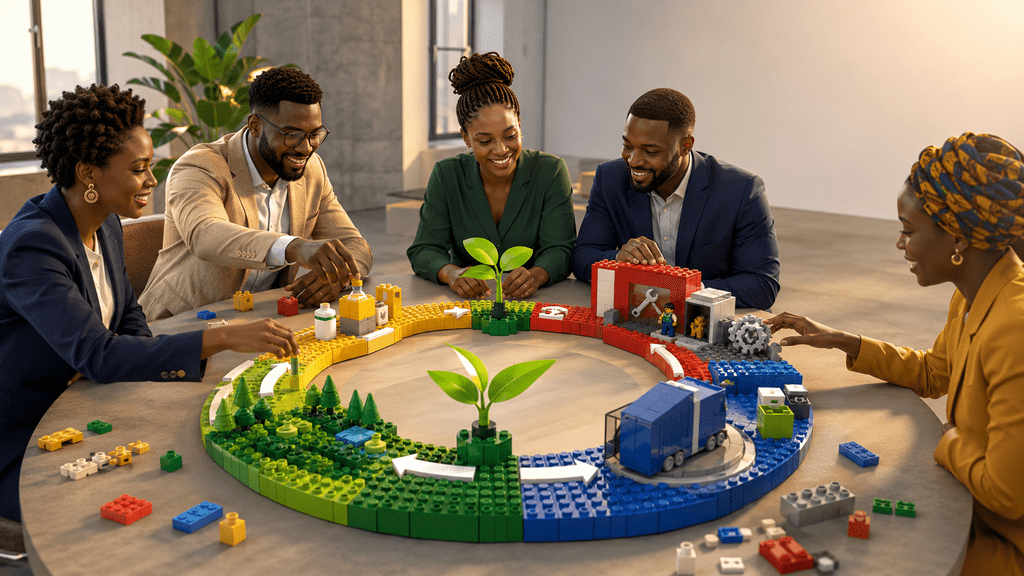

The circular economy is often taught through diagrams filled with loops, arrows, value chains and life cycles. Those diagrams are useful, but they can also make a circular economy feel distant from the everyday decisions that businesses must make. LEGO Serious Play brings the discussion back to the table, quite literally. It asks people to build what they mean, explain what they have built and test whether the idea can survive contact with reality. My interest in this method began with a visit to a friend. Her household has four children, aged between four and twelve, and I had no idea what gifts to buy. The adults could buy their own gifts. The children were my concern. I stopped at a local shop and bought four LEGO sets: a rocket, an excavator, a ship and a tank. I felt rather pleased with myself, partly because I assumed the children would struggle with the instructions and eventually call on the wise adult in the room. That confidence lasted only a few minutes. I could barely follow the manual, while the children quietly worked out what went where. Soon, a rocket began to take shape.
That was my Newton moment. If children could use bricks to turn an idea into a working model, could adults use the same approach to understand the circular economy? Could a team build a product system, expose a broken value chain, redesign a reuse model and see why a promising circular business might fail? I enrolled in training, bought my first LEGO Serious Play kit and began exploring the method more seriously.
The answer, I have learned, is yes. Used well, LEGO Serious Play can make circular economy training more practical, inclusive and commercially relevant. The value is not in producing an attractive model. The value lies in making assumptions visible, allowing different perspectives to meet and turning a complex system into something a team can question and improve.
Why circular economy training needs a different method
The circular economy is not another name for recycling. It is a systems approach that aims to eliminate waste and pollution, circulate products and materials at their highest value and regenerate nature. For a business, this means asking how products can remain useful for longer, how materials can return safely, how ownership may change and how value can be created without relying on constant extraction and disposal.
These are not only environmental questions. They are questions about customers, suppliers, design, logistics, finance, data, regulation and behaviour. A refill system may look sensible on a slide but fail if customers do not return containers. A repair offer may collapse if spare parts are unavailable. A recycling business may struggle when collected material is contaminated or prices are unstable. Circular economy training must therefore connect principles to the conditions in which a business actually operates.
Traditional presentations can explain life cycle thinking, product stewardship, industrial symbiosis and extended producer responsibility. They do not always help a team redesign a business around those ideas. LEGO Serious Play helps close that gap because participants construct the system, interpret it together and change it in response to evidence and constraints.
What LEGO Serious Play contributes to the circular economy
LEGO Serious Play is a facilitated method in which participants use LEGO elements to represent ideas, relationships, risks and possible solutions. The LEGO Group traces the method to strategic planning work that began in 1996 and later released it as a community based model under a Creative Commons licence. Its official background describes the method as a way to encourage people to participate, contribute and commit to a solution.
A participant may use a bridge to represent trust between a producer and a recycler, a red block to represent regulatory risk, a transparent piece to represent traceability or a gap to show missing infrastructure. There is no universal meaning assigned to a brick. Meaning comes from the builder and is clarified through explanation and questions.
This makes the method well suited to circular economy problems, which are rarely confined to one department or organisation. Participants can see where materials enter, where value is added, where information disappears and where products leave the system. When the model changes, the consequences become easier to discuss.
Lesson 1: Find the circular economy starting point
A productive circular economy workshop begins with the current linear model. Participants build how raw materials, products, money, information and waste move today. They show who makes decisions, who bears costs and where responsibility ends.
Once the current system is visible, better questions emerge. Where is value being lost? Which material leaves the business too early? What frustrates customers? Which cost is hidden inside disposal, returns or damaged stock? A team should understand the present system before drawing a circular loop around it.
Lesson 2: Expose hidden circular economy assumptions
Many circular economy ideas fail because important assumptions remain unspoken. A model may depend on customers returning packaging, retailers providing storage space, recyclers accepting a certain grade of material or regulators approving a new arrangement. When participants build those relationships, assumptions stop hiding inside a spreadsheet or presentation.
The circular economy model gives the group something concrete to challenge. A procurement officer can show why recycled material is difficult to source. A warehouse manager can point to packaging losses. A technician can identify the component that fails most often. The conversation becomes less about defending positions and more about improving the shared model.
Lesson 3: Design circular economy business models by hand
After mapping the present, participants rebuild the system so products and materials stay in use. They may add repair points, collection routes, refill stations, shared ownership, digital tracking, refurbishment centres or recycling partnerships. The circular economy begins to look less like compliance and more like business innovation.
Several circular economy business models can be explored. A product as a service model allows a company to retain ownership and earn income through access, leasing, maintenance or performance. A repair and refurbishment model brings products back for diagnosis, restoration, quality assurance and resale. A refill and reuse model shows packaging moving between customers, retailers, cleaning facilities and producers.
Industrial symbiosis can also be built, showing how a byproduct from one company becomes an input for another. Organic residues may become compost, animal feed, biochar or biogas, depending on safety and technical requirements. Textile offcuts may become new products. Plastic waste may be processed into secondary raw material where quality, demand and economics allow.
An extended producer responsibility model can map producers, consumers, collection points, aggregators, recyclers, producer responsibility organisations, regulators and data systems. The model makes one lesson clear: a circular economy usually depends on coordination across many actors, not the effort of one company working alone.
Lesson 4: Stress test the circular economy model
A circular economy model should be tested before it becomes an investment plan. The facilitator can introduce realistic shocks. Collection costs rise. Customers do not return products. Recycled material fails a quality test. Regulation changes. A partner withdraws. An investor asks for verified impact data.
Participants then adjust the model. They may change incentives, redesign a return point, add a quality control stage, simplify the material mix or find a different revenue stream. This stress test reveals whether the idea is resilient or simply attractive. It also exposes which assumptions require research, piloting or negotiation.
Lesson 5: Give every voice a place in the circular economy
In many workshops, the most senior or confident people dominate. Yet the people who understand operational problems are not always the people who speak first. LEGO Serious Play uses a build and share process in which each participant creates a model and explains it. That structure can broaden participation and bring practical knowledge into the circular economy discussion.
This matters when government, businesses, financiers, informal waste workers, recyclers, young entrepreneurs and community organisations need to work together. Their interests are different, but the shared model gives them a common object around which to negotiate meaning, responsibility and action.
Lesson 6: Turn the circular economy model into a business case
Play is the method, not the final output. A strong circular economy session should end with decisions. The team can translate the model into a circular business model canvas, a material flow map, a stakeholder map, a risk register, an implementation plan or a set of performance indicators.
Before leaving the room, participants should be able to answer the following questions:
- Which product or material will remain in circulation?
- Who owns or controls it at each stage?
- How will it return, and who will pay for collection, cleaning, repair or processing?
- What data, standards and quality controls are required?
- Which partnerships make the model possible?
- What revenue model makes the proposal commercially viable?
- Which environmental, social and business outcomes will be measured?
If the group cannot answer these questions, the model is still an idea. That is not failure. It tells the team where further analysis is required before money and reputation are placed at risk.
Lesson 7: Adapt circular economy training to the audience
For small and medium enterprises, LEGO Serious Play can translate circular economy language into practical business choices. Owners may not use terms such as closed loop systems, but they understand material losses, customer complaints, cash flow and survival. A model can help them identify byproducts, repair opportunities, packaging improvements and partnerships with nearby businesses.
For larger companies, the method can support innovation, environmental, social and governance strategy, waste reduction, product redesign and extended producer responsibility. Teams can examine packaging, supplier relationships, reverse logistics, customer engagement and reporting requirements without treating each issue as a separate conversation.
For development programmes and public policy processes, the method can support entrepreneurship training, green jobs initiatives, circular economy accelerators and policy co creation. It is particularly useful when people with different levels of technical knowledge need to understand the same system and agree on feasible next steps.
A practical circular economy workshop flow
A circular economy workshop can run for one day or form part of a longer programme. The time available should determine the depth of analysis, but a practical flow includes six stages:
- Introduce the principles and connect them to competitiveness, resilience, resource security and environmental performance.
- Build the current system, including the movement of products, materials, money, information and waste.
- Identify leakages, pain points and opportunities for retaining value.
- Redesign the system around reuse, repair, sharing, refill, remanufacturing, recovery, recycling or industrial symbiosis.
- Stress test the proposal against customer behaviour, logistics, quality, policy, finance and data constraints.
- Convert the model into a business case, pilot plan, responsibilities, indicators and next actions.
The session must be designed around a clear business or policy question. LEGO bricks do not replace market analysis, engineering, financial modelling or regulatory advice. They help a team frame the problem, combine knowledge and decide what must be tested next.
From abstract circular economy ideas to practical action
The circular economy is both a technical transition and a change in how people think about value. Businesses must learn to see waste differently, design products differently, collaborate across organisational boundaries and measure success beyond the first sale.
LEGO Serious Play can make that transition easier to discuss because it turns an abstract circular economy idea into a shared and visible model. Teams can build the problem, redesign the system, test the business logic and agree on action together.
The method is not a substitute for evidence. Its strength is that it helps people decide which evidence they need and where the real risks sit. In a world where organisations must reduce waste, respond to regulation, create green jobs and strengthen supply chains, circular economy training should do more than explain. It should help people imagine, test and act.
That is what LEGO Serious Play can offer: a disciplined way to build the future before investing in it.
Selected sources for publication
These sources support the article’s core definitions, methodology background, practical application.
- Circular economy principles: Ellen MacArthur Foundation, Circular Economy Introduction
- LEGO Serious Play background: The LEGO Group, What is LEGO Serious Play?
- Documented workshop application: Cambridge Institute for Sustainability Leadership
Also checkout